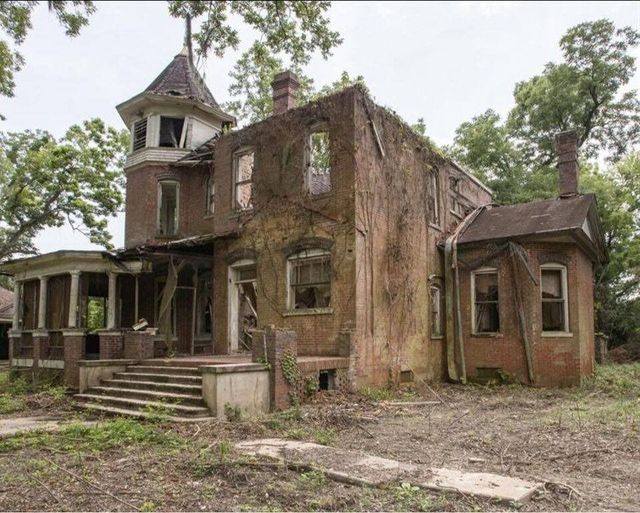
Urban explorer and photographer Leland Kent, the creator of Abandoned Southeast, has documented countless forgotten properties across the American South. Among his most striking discoveries is a late-19th-century brick mansion built in 1899 for Robert H. Moulthrop, a state senator remembered for his work on education reform in Alabama. Even in its abandoned condition, the house commands attention. Its size, symmetry, and craftsmanship reflect an era when homes were built to convey permanence and pride, offering a glimpse into both political history and architectural ambition.
The mansion was designed as a blend of Imperial Revival and Queen Anne styles, a combination that gives it a stately yet ornate appearance. A turret rises above the structure, once providing panoramic views of the surrounding land, while decorative brickwork and tall windows hint at the elegance the home once displayed. The residence includes five bedrooms and generous living spaces, clearly intended for both family life and formal entertaining. Despite decades of neglect, the house still feels like an architectural gem, its design strong enough to shine through even as nature and time slowly reclaim it.
One reason the home has endured as long as it has lies in its exceptional construction. Moulthrop and his family owned one of the largest brick manufacturing operations in the state, and the quality of materials used in the mansion reflects that advantage. In some areas, the exterior walls are an impressive six bricks thick, helping them remain largely intact. The columned veranda still stands as evidence of this durability, with solid brickwork contrasting sharply against the collapsed roof and weakened interior framework. From the outside, the house appears resilient, almost defiant in the face of decay.
Stepping inside, however, reveals a far more fragile reality. Large portions of the roof have fallen into the main rooms, leaving piles of debris scattered across the floors. What was once a graceful fireplace has deteriorated into a crumbling cavity, and interior walls have buckled under years of exposure. Even rooms that retain original features, such as tiled bathrooms, show signs of serious structural damage, including warped walls and unsafe flooring. The mansion remained in the Moulthrop family until the 1980s, when it was sold and gradually abandoned. Today, it stands as a powerful reminder of how quickly grand spaces can fade without care, while still holding the quiet dignity of its remarkable past.