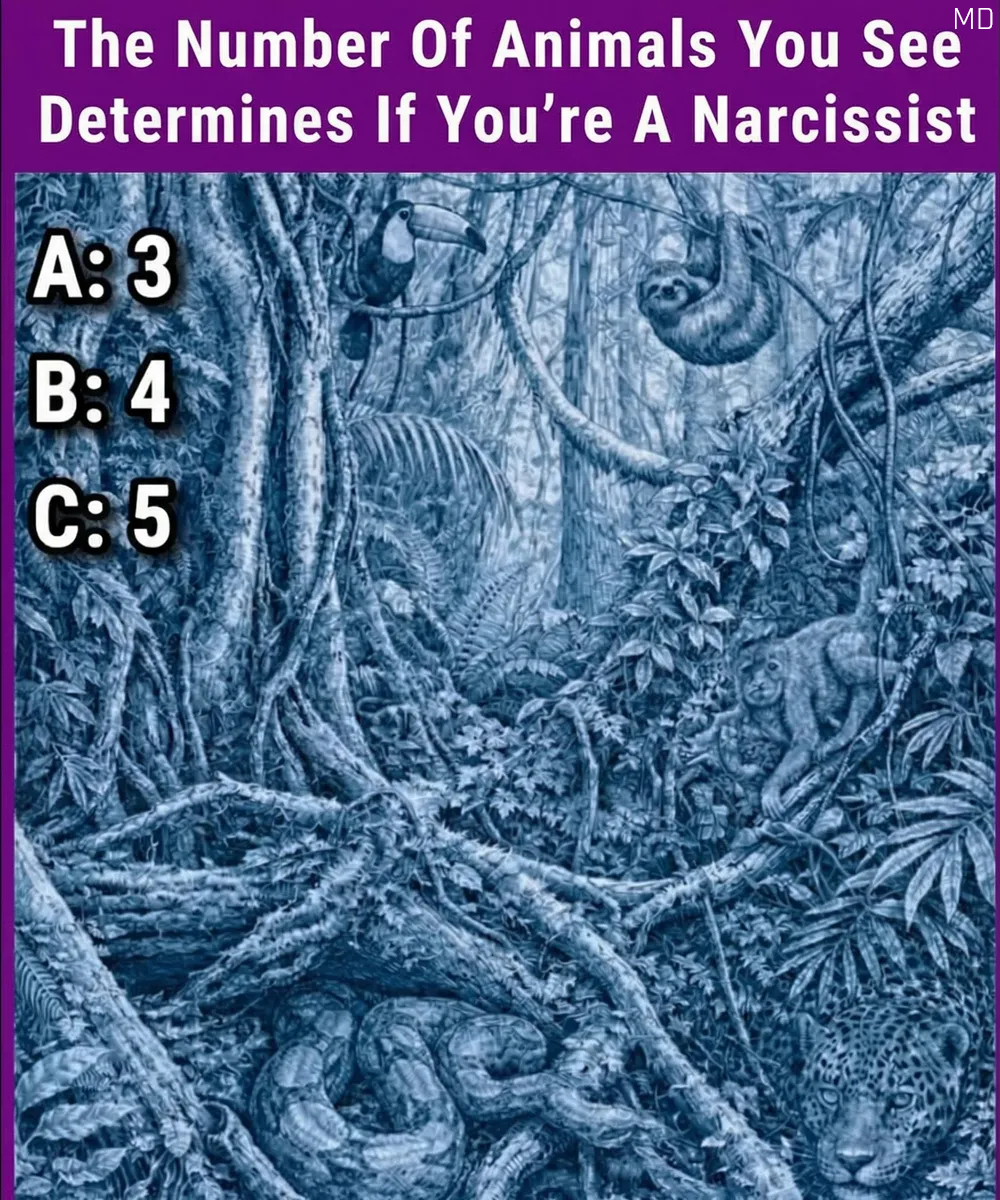
At first glance, the detailed jungle illustration appears to be nothing more than a lush forest scene. Thick roots curl along the ground, vines drape from branches, and layers of leaves overlap to create a rich green canopy. But as your eyes adjust, shapes begin to emerge from the foliage. Hidden among the trees are several cleverly camouflaged animals, blended so naturally into the environment that spotting them requires patience and focus. What seems simple at first quickly becomes a playful visual challenge.
Many versions of this image come with a bold claim: “The number of animals you see determines if you’re a narcissist.” Viewers are often asked whether they spotted three, four, or five animals. With a closer look, you might identify a toucan perched on a branch, a sloth hanging from a limb, a snake coiled near the forest floor, a monkey tucked into the greenery, or even a large cat resting in the shadows. Some people immediately notice a few animals, while others take more time to uncover them all.
Despite the dramatic headline, there is no scientific evidence linking the number of animals you see to narcissism or any other personality trait. Narcissism is a complex psychological characteristic that exists on a spectrum. At mild levels, it may show up as healthy confidence or self-assurance. At higher levels, it can involve an inflated sense of importance, difficulty empathizing with others, or a strong need for admiration. In clinical settings, Narcissistic Personality Disorder is diagnosed through thorough evaluation by qualified mental health professionals — not through visual puzzles or internet images.
So why do headlines make such bold claims? Because they spark curiosity. Optical illusions and hidden-image puzzles are popular precisely because they invite self-reflection and conversation. The number of animals you see may reflect how carefully you scan details, how patient you are, or how your brain processes patterns — but it does not define your personality. Instead of treating the image as a psychological test, it’s better to enjoy it as a fun exercise in observation. Sometimes the real value isn’t in what the image says about you, but in how it encourages you to slow down, look closer, and appreciate the details hidden in plain sight.